Hello readers, it’s time for one last blog post. Firstly, thank you for joining me along my reflective journey where I have been learning so much about Music. I have learnt new and exciting things about music that I wouldn’t have known if I hadn’t of done this blog.
Over the past few weeks, my blog has been a secret escape for my mind to let loose and explore deeper into the world of music, allowing me to progress my knowledge even further and opening my eyes to whole variety of musical pathways.
Not only has writing this blog instilled a new form of confidence and security in me, it has been a great way for me to see my progress of what has been influencing my creative thinking.
After reading through lots of peer related sources and completing extensive qualitative research, I can see that music has had an astronomical impact on society throughout the years.
As my first semester for my masters course draws to a close, I am happy to say that blogging my creative journey has been nothing more than an enjoyment to me. My fingers have gone from playing a piano keyboard to playing a computer keyboard, it has allowed me to improve my academical skills in the sense of writing since i’m used to using the creative part of my mind. This blog has taught me how to express my thoughts down onto paper, similar to how a piano helps me to express my thoughts down onto a keyboard.
I hope my blog has helped other confused musicians or just anyone who isn’t sure on what path to take in life. I have used the time writing this blog to help organise my mind a little better and to plan out my future. My plans are more clear of which way I want to go in life and how to solve problems when faced with them.
I have learnt that I am not alone in this creative industry and that help is always available when needed and that generations of musicians have helped carve out a shortcut to a sucessful career for the new generation of musicians like myself by giving music a name and establishing that music is a ‘real’ career and success is possible.
As I was updating my blog, I noticed that the world of music was also updating too, it’s such a fast paced industry that’s forever evolving. I learnt that in order to be successful, I must be relevant and I too must evolve with the industry.
Overall my research throughout my blogging has allowed me to become more open minded and observant of the creative events that are happening around me. From the new Star Wars (2019) film set to release to the recently released Call of Duty (2019) game, to ‘Kanye West’s’ Opera, the creative world is open to everyone, if there’s one thing I’m sure of, it’s the amazing industry I have become apart of and dedicated my life to for all these years.
My main approach behind my research was to either find educational sources such as university papers, dissertations or thesis’s and I researched books and youtube videos.
I felt more confident choosing these sources as they’re more likely to be accurate and full of important information. For example, academic research papers, dissertations and thesis’s are reliable sources of information as an extensive amount of research goes into them, they also must be backed by a large number of references.
Books were another great source of information, especially when I was writing about non modern topics such as late 1800 composer’s and female composers in the 1900’s. The books were slightly older in date but that meant they were closer to the time of when those events occurred which I felt was accurate information to be reading from.
Youtube videos were also a great help to me as I’m a visual and auditory learner so information goes in best when it’s being described to me or presented in a visually pleasing way.
The process’s I decided not to take was to find online articles from unreliable sources like Wikipedia. This is because those types of online articles are accessible to the general public who can edit the information themselves, therefore the data isn’t reliable.
I also avoided non-certified Youtube accounts to source my data. When gaining information by watching videos, I only reviewed the ones that were posted by official Youtube user’s that discussed accurate information in their videos. Also, when discussing certain artist’s in my blog posts, I watched official interviews that contained the people I was talking about so I am getting a source of secondary data but from a first person point of view.
I another approach I left out was to avoid personal beliefs and primary research from other people. I read sources that emphasised the importance of objectivity and mainly wrote about sources that were backed by numerous facts.
However, I was subjective to certain topics I discussed as I have a strong passion for Music and equality so I guess I can say that I was conducting a mixture of objective and subjective research. The subjective research was me trying to find objective sources that I thought fit my interests and passions.
This links to reflexivity and how my subjective views could affect my qualitative research but in an attempt to limit subjectivity, I must reinstate the fact to the reader that my own reflections in my research are a necessary factor to good research, my blog is written in first person so my subjective opinion will appear throughout my posts but a good balance of subjective and objective research can overall make an unbiased blog .
Creative processes behind composing:
The inspiration behind my creative processes will always come from other musicians and composers, whatever I think sounds nice, I will study and incorporate in my music. Whether I accidentally come across a nice tune or learn to play a new piano piece, if my ears prick up to nice harmonies and melodies, I will study how those artists created that sound and I will try to recreate but still be unique to myself
My intial ideas to a creative process will start off with me sitting at a piano and improvising, it takes time before an idea is explored into something bigger but once inspiration sets in, my compositional strategies will advance and help me create a piece of music.
Once I have captured the idea I created on the piano, I will take a technical approach to my work by translating my piano improvisation onto my laptop and use the software ‘Logic’ where I have a template of instruments that replicate a full orchestra, from this step, I can then turn a simple piano idea into a full orchestral piece of music. Once my composition has been created, I will share it to SoundCloud where people can comment on my work and give me feedback.
However, sometimes an idea can be a spur of the moment creation and to review my compositional development I will often ask for the support of both musicians and non muscians to give their opinion on my musical idea before I adapt it any further. Having a mixture of non musicians and musicians listen to my work shows an unbiased review on my music. Social media platforms are a good but risky way of getting honest feedback from people who may not know you, the feedback can be very honest on social media platforms but you are then vunerable to internet ‘trolls’ and harsh comments.
If the quality of my work is not up to a professional standard from what feedback says of my compositions then I try to inspire myself and listen to different styles of music to see which style I write best in. I’m also not afraid to ask for help from my peers and fellow musicians to advise me on how to improve my compositional skills. Also when composing pieces of music for University assignments, my lecturer will always give me feedback on what I need to improve or change.
Overall I am happy with compositional processes because I’ve constantly been adapting the way I write music since I was young. I’ve grown up and experienced different styles of writing and I’ve also been taught by many music teachers, all of whom have a different outlook onto the music world. Music is a very subjective field of work, therefore I am aware that self confidence plays a vital role in a successful career as not everyone will like your music, but the people who do will lead you to a successful path.
Do I compose music for Film? Do I compose music for games? Do I become a sound designer? Shall I become a professional pianist?
Well, this blog post is going to be about me laying my options out on the table and what I think will benefit me the most. You, as the reader, can be my audience and maybe this blog will help you figure out the path that’s best for you.
I can say now that by the end of this post I will still not know what path I want to choose to go down but I will at least have a plan ready. As I write this, I am still currently on my Master’s course but once I’ve graduated, I’ll be out into the real world and I will need some guidance.
Film, Game, Sound Design and Piano are the 4 pathways that I have chosen analyse. I will outline the pros and cons of each pathway to make a clearer view on which career would benefit me the most.
Firstly, for my research, I looked up interviews with industry professionals. I watched interviews with Film and TV Composer ‘Sherri Chung’, Games Composer ‘Laura Shigihara’ and Sound Designer ‘Karel Psota’.
I made notes whilst watching each video to outline the pros and cons of their profession.
‘In the Studio with Composer Sherri Chung’ notes and annotations:
-She’s classically trained
Like myself, I too am classically trained, so I feel I have an advantage
-She didn’t “stumble” into the job, every decision she has made is the reason she’s where she is today
This shows that I must work hard and not wait for something to happen in order to be successful
-She started by designing sound for ‘Blindspot‘ (2015)
I can use sound design as a gateway to Film and TV composing
–Technologyis necessary as it’s hard to present yourself withoutit
In the interview, she explained she uses the music software Logic and recommends that you must present your work electronically as that’s the industry standard. This is reassuring to me as I’ve been presenting my work electronically for years and I too use the software Logic.
You need patience and to build up a relationship with producers and directors
This was useful to me as I have yet to work with producers and directors but at least I will know to be patient and understanding when it comes to working with other professionals.
Mixing engineers will do the work for you
One thing I was always worried about was the fact that if a director wants live music, I’d have to compose the music, orchestrate it, conduct the orchestra and mix the live recordings. I have done this on a small scale but never as big as a full orchestra but Chung made me aware that there are people who can do that for you.
‘Interview with Games Composer Laura Shigihara…’ notes and annotations
Classically trained on the piano
Like Chung, Shigihara is classically trained and on the piano too. Seems like most composers have that skill under their belt, something I need not worry about.
Her first soundtrack she composed for free and then was hired
This is a huge risk that Shigihara took, her humble attitude towards her music meant that she was setting herself short but luckily it paid off. This is inspirational to me as I have composed music for free for fellow game and film students and if I need to take that risk in future I will but I shall not set myself short.
Don’t compose melodic patterns as this can grate on the player’s ears
I have composed subtle and ambient tracks before due to an assignment that requested this. My lecturer wanted our class to compose tracks suitable for gameplay and none should be noticeable or constant. I would be prepared to write tracks for games as I’ve had the experience beforebut only in class.
Game composing is different to film composing as it’s not linear
This was something that worried me as I am not too aware of the technical side to music implementation in games, I struggled with this in assignments where I had to implement audio into ‘Unity’ (A Game Engine’) but the composition side was very much enjoyable as it was linear.
Interview with Sound Designer Karel Psota… (2018) notes and annotations:
There are different ways to create an income as a sound designer, one is to release your album of sound design and sell it or work for a music production company, according to Psota, both are successful but contain flaws. Money is higher in the music production companies but expect a delayed payment by 4-6 months. Owning your sound design and selling it is a stable and “passive” incomebut it’s dangerous to have your name out in the music industry as a solo artist because if you do a misstep, you could tarnish your image.
This interview was more of an insight into how to make a living in that line of work. This was extremely helpful as not only did he discuss different paths of sound designing, he wasn’t biased and gave an honest opinion of each path to go down.
I was a pianist before I became a composer, so I know that no matter what, I will always have my piano to fall back on. I didn’t need to research into interviews with Pianist’s as I feel confident enough to identify as an industry experienced Pianist myself. Before I came to University I was teaching piano to anyone who needed to learn, I was also performing at award ceremonies and weddings but when I came to University, the Piano wasn’t my main focus anymore and composing became my passion.
After research into these four pathways, I concluded that being a Film Composer feels like the most exciting path for me to take, although similar to Game Composing, Film and TV has a much more linear approach and I can be inventive with my music whereas game music seems restrictive as repetitive melodies and certain musical approaches are not recommended. Sound design is interesting however it has only just become new to me and to give up composing would be a real shame. The Piano will always be my back-up career, I have received a degree in Music and qualifications grading my Pianist skills, I feel confident that if a career in composing doesn’t kickstart, then Piano will be my fall back and I can honestly say that I will be happy with that, as long as I’m teaching piano, performing at venues, weddings or just doing something that involves music, I’ll be quite content.
Sources: SAMPLE LIBRARY REVIEW Interview With Sound Designer Karel Psota • Trailer Sound Design: From Source To Cinema Instructor(2018) {ONLINE VIDEO} 9 MAY 2018, ACCESSIBLE BY LINK: https://www.youtube.com/watch?v=qgIn1TMHLRg&t=1309s (video accessed on 6th December 2019)
COLOGNEGAMELAB Interview with Games Composer Laura Shigihara (Plants vs. Zombies) (2012) {online video} 7th March 2012 https://www.youtube.com/watch?v=x7_9rzSMP7U (video accessed on 6th December 2019)
SOUNDIRON In The Studio with Composer Sherri Chung | Soundiron (2019) {online video} 11 March 2019https://www.youtube.com/watch?v=fsCrvvV0694 (video accessed on 6th December 2019)
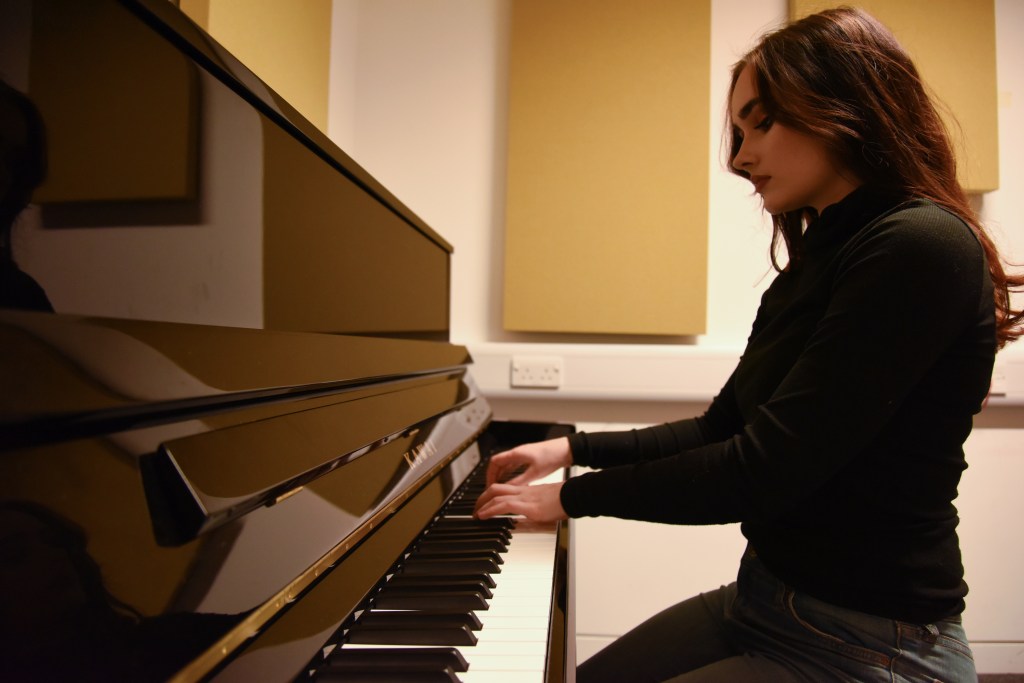
Here’s a pretentious picture of me trying to look like I know what I’m doing…
So we’re deep into the blogs now, I believe this is my 7th blog, we should know each other by now. My loyal readers will know that I’ve been playing the piano since I was 7, I’m now 22, that’s a very long time, I’m surprised my fingers don’t have biceps.
The piano is the biggest influence on my music, the minute I think of a musical idea, I will go straight to a piano and write it out on some manuscript paper. I even use a digital piano to electronically write in all my ideas using a midi keyboard and Logic Pro X.
My biggest inspirations:
-Debussy
-Liszt
-Einaudi
and even famous YouTube pianists such as :
-Rousseau
-Patrik Pietschmann
-Davide Stramaglia (aka David’s Pianosound)
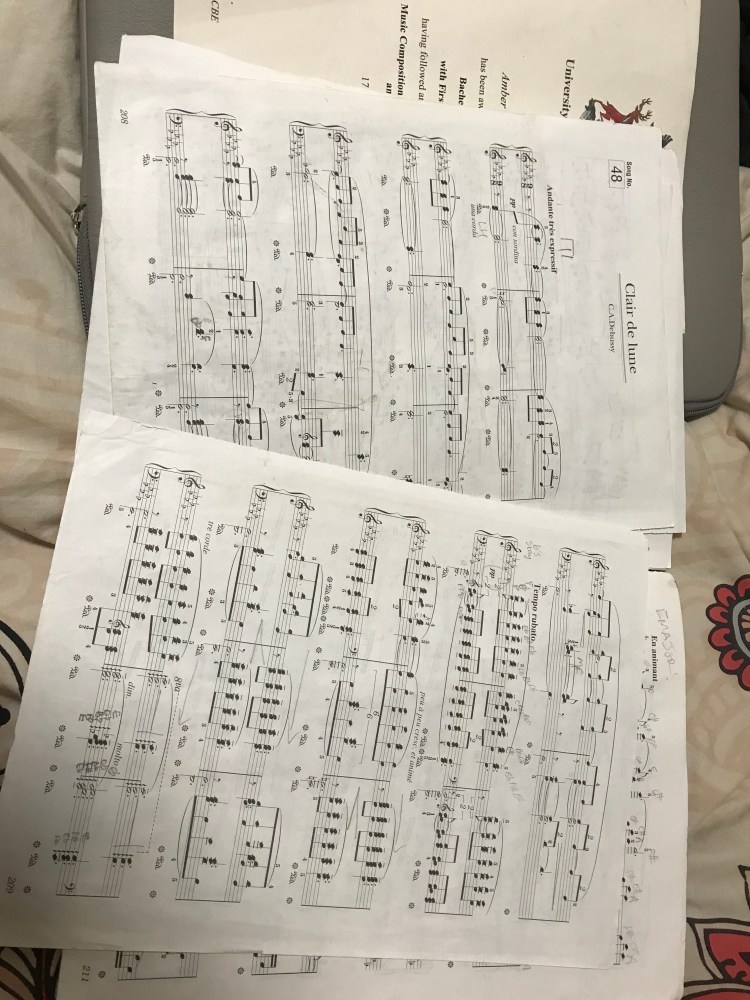
Whilst I compose, I also practice famous pieces of piano music to help inspire a creative spark to light up in my mind ready for my next composition. I’m currently practising ‘Clair De Lune’ (Debussy 1890), to be fair I’ve been practising ‘Clair De Lune’ since I was 13 and I just can’t master it, but I’m close! Thanks to the amazing facilities at my University I have access to top of the range pianos which makes practising a lot more enjoyable.
Picture of Clair de Lune sheet music that I’m currently learning
Please excuse the tattered piano sheet music, the amount of times I’ve launched it across the room because I couldn’t hit the right note,( I know right how childish) but Debussy’s pieces are so difficult play, I even found the time to research into why this is and came across a research paper written by Chieh Chien called ‘Beyond Debussy and Ravel: Impressionism in the Early Advanced Short Piano Works of Selected European and American Composers’ (2011) Chien states that “Keeping the appropriate lightness of touch and a good balance between independent finger’s and rotated wrists is a challenge for pianists” (Chien 2011)
This reassured me reading this, I was beginning to doubt my pianistic skills, turns out Debussy is just extremely talented and difficult to replicate.
How to sound like Debussy by Nahre Sol (2018) accessed via YouTube
Above I have attached a really helpful video because I was infatuated with the Sound of Debussy, I wanted to incorporate his style into my music and this video helped me a lot with my own piano compositions.
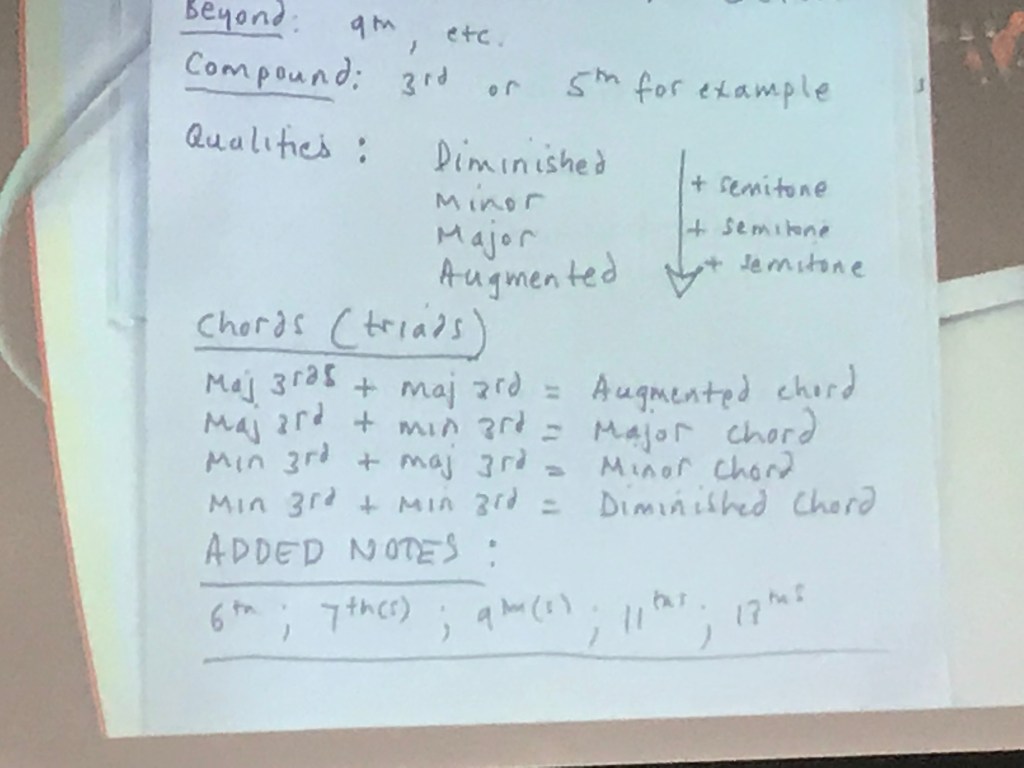
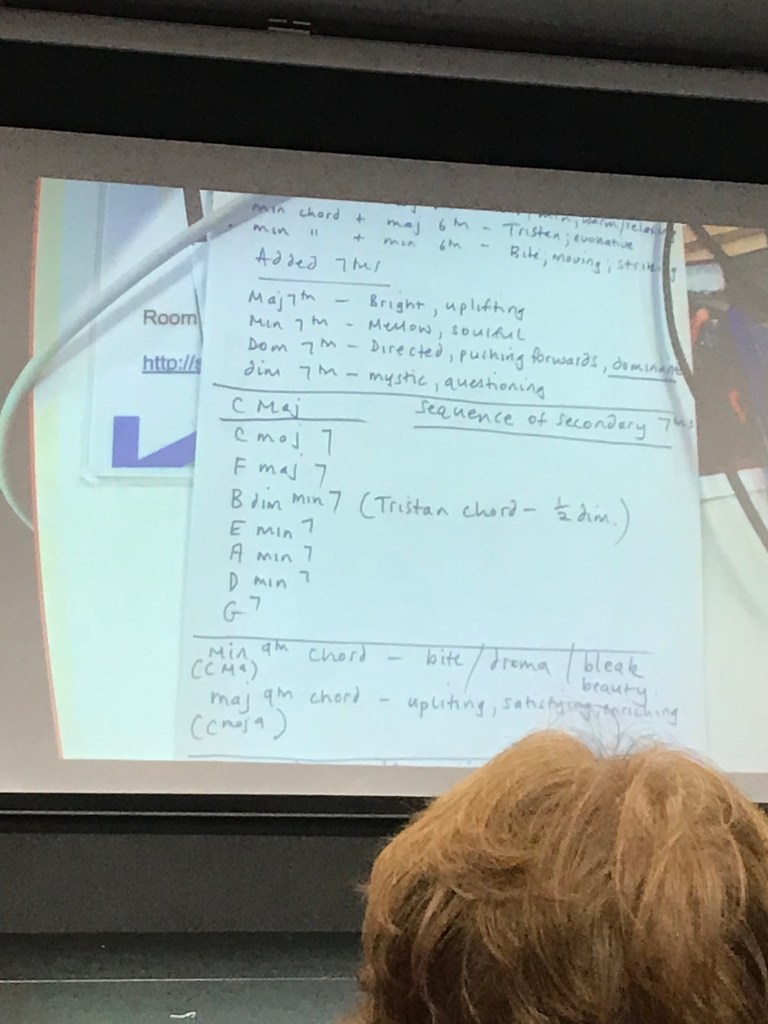
In my 3rd year at University, one of my assignments was to create a track with vocals in, I wanted to create a piano part to accompany the vocals but after I composed my first draft, my lecturer said there wasn’t enough “magic” in there and there needed to be more harmony. So I asked my lecturer if he could show me how to do that, the following day he taught a whole lecture on harmony and how to bring that “magic” into your music, here are some of the notes written from that lecture:
Notes taken from lecture at University of HertfordshireFurther notes from lecture at University of Hertfordshire (excuse the furry head in front of me)
This lecture was so helpful to me as it made me re-evaluate my own compositions and I decided to take a new approach to composing music, below is a link to the composition I composed for that assignment:
However, before Debussy started to influence my work, I took a less complex way of composing. This was due to my interest in ‘Einaudi’ his music is fairly easy to sight read and simple to play yet it’s written with such beautiful and calming melodies.
An example of my music before Debussy influenced my compositions, can be found on my SoundCloud link below, in this composition I wrote in the style of Einaudi, a simple piano piece, not too harmonic but full of calming melodies.
As I mentioned earlier in this blog post, I talked about my inspirations on Youtube. Patrik Pietschmann and Rousseau
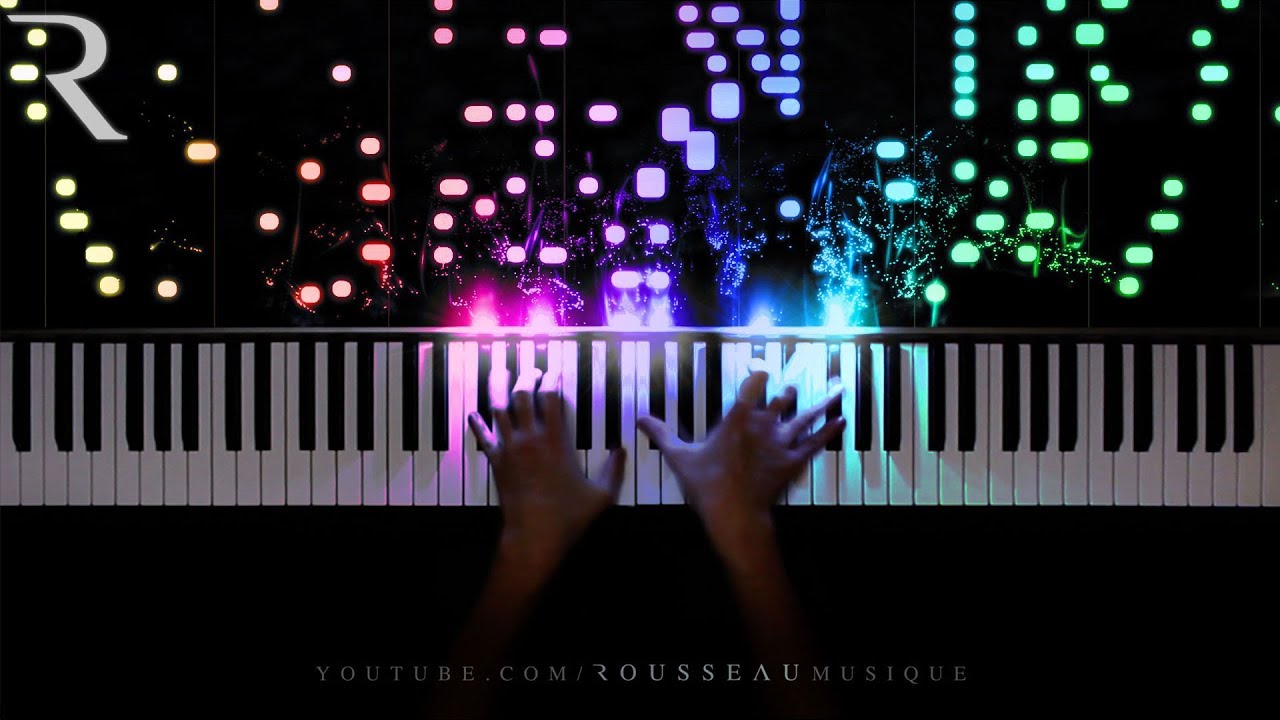
Rousseau, Youtube Pianist who uses reactive visualiser.(2018)( accessed via google images) Patrik Pietschmann, Another Pianist that uses reactive visualiser (2019) (accessed via google images)
Both of these Youtube Pianist’s use a ‘reactive visualiser’ this gives music a ‘face’ to look at, perfect for non pianist’s to help them understand what these notes do and how they create something so magnificent when all combined together.
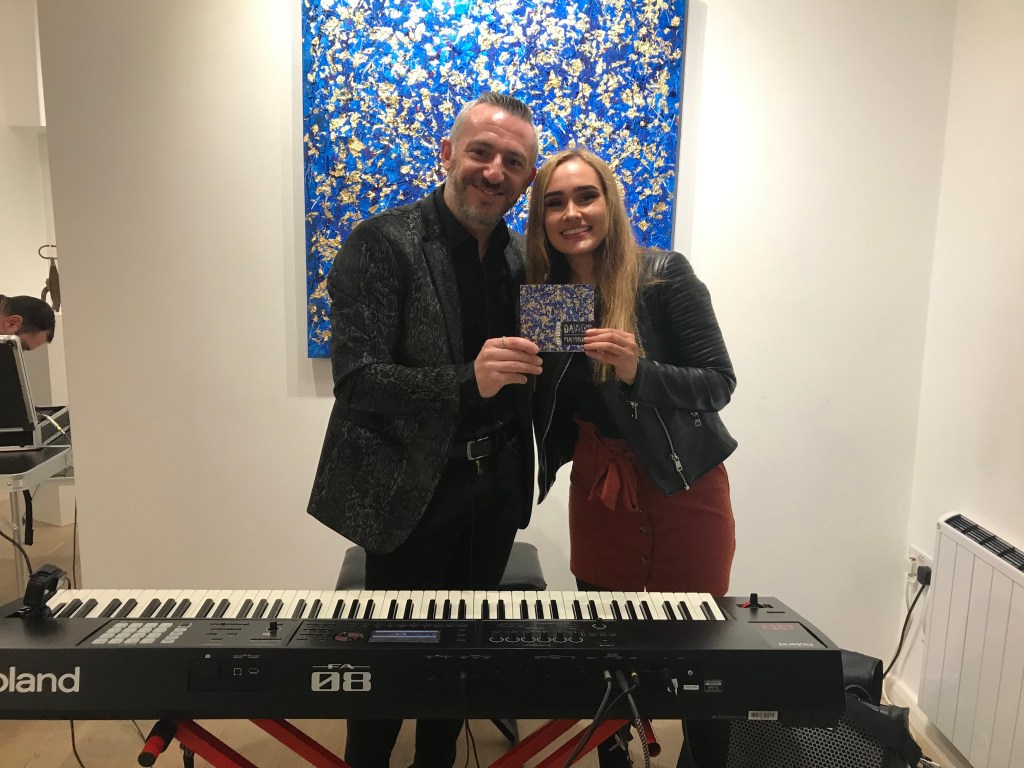
Davide Stramaglia and myself promoting his new album at an Art Gallery he was performing in
It’s not often that people get to meet their inspirations but luckily I did. In the picture above, myself and pianist Davide Stramaglia aka (David’s Pianosound) finally managed to meet up after nearly 2 years of when I first saw him perform at ‘Westfield Centre’ in London. He caught my attention immediately when I heard him playing so beautifully on the grand piano on the second floor of the Westfield Centre. I was astonished to find out that the songs he was playing were his own original compositions. Once he had finished playing, we started chatting and stayed in touch ever since. He has been a great contact to have, especially since we’re both in the same industry, his tips and advice has helped me develop into a better pianist and composer. Davide has not only released two piano albums, but has also hit over 8 million views on his Youtube video.
PiratesOfTheCaribbean/GameOfThrones Piano by David’s Pianosound (2016) Youtube
This type of path in the music industry is becoming more common with the rise of YouTube and the modern day ‘Youtuber’s’ that are releasing content every day are earning a good living from it. After watching these videos I have considered going down the route of Youtube and showcasing my music that way.
Sources: CHIEH CHIEN, ‘Beyond Debussy and Ravel: Impressionism in the Early Advanced Short Piano Works of Selected European and American Composers’(2011), {accessed online}, Arizona State University, link to research paper can be found:https://pdfs.semanticscholar.org/cf98/eb25c3de853681711873ecb6f57d5e5c5678.pdf (accessed on 5th December 2019)
You may be looking at this title and thinking to yourself, what the heck is this girl on about. Well let me clear things up for you. I am currently 4 months into my Postgraduate course and i’ve already completed 2 sound design assignments.
As a composer, these 2 assignments were a real shock to my system, for once I not only had to create the music but the sound effects too.
Chirality (2015)
Chirality was my first sound design assignment for my Postgraduate course, I was faced with the challenge of designing every little bit of sound that I thought would occur alongside the footage. For example, the story behind the Chirality video is a small little creature exploring a cave, he so happens to see a crystal sticking out of a ‘rock’, he pulls the crystal out (like an absolute thief) and awakes a beast who is actually the ‘rock’ (no, not the WWE superstar). A chase scene occurs and eventually the small creature falls into a pit of lava along with the crystal he stole, ( sounds like LOTR to me). So all of those events occuring in that video, I had to design the sound for.
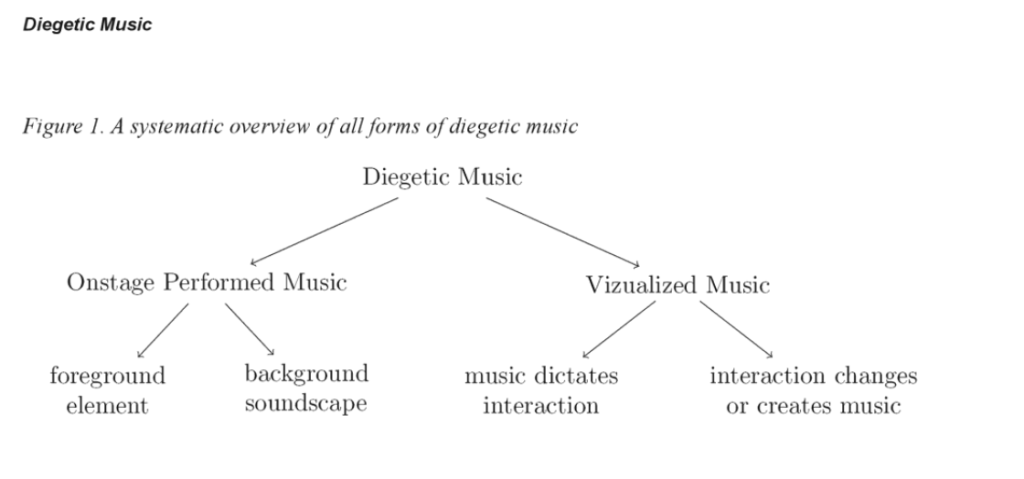
In order to prepare myself for this assignment, I had to dive into the world of sound design, this involved me reading books, such as the Sound Effects Bible (2008) by Ric Viers and taking down notes of everything my lecturer said. An important key word my lecturer uses is “diegetic” and “non-diegetic”. In order to properly study this terminology, I researched an Ebook of concepts written from other University professionals called ‘Game Sound Technology and Player Interaction: Concepts and Developments’ by Mark Grimshaw (2011) and came across a segiment on page 60, chapter 4, about Diegetic Music written by Axel Berndt from Otto-Von-Guericke University.
Berndt describes that “Music which is performed within the scene is called diegetic” (Berndt 2011 p.g. 60 )
A screenshot from ‘Game Sound Technology and Player Interaction: Concepts and Developments’,(2011)
Having read into Berndt’s clear definition of “Diegetic” I was aware that the sound design I was creating was going to be “Diegetic” and the music was going to be “non diegetic”
The technological side behind the creation of Chirality stems from the equipment I used which was an AKG C480B microphone to capture the foley I created and incase you’re wondering what foley is, feel free to access my previous blog post where I have inserted a few videos on foley.
Another great source that describes Foley is a thesis on ‘Foley Music :An Exploration of the Relationships between Sound Design and ‘Music’ in Film‘ by Diale Daniel Mabitsela (2016), Mabitsela talks about the film ‘No Country for Old Men’ (2007) which funnily enough I have an assignment based on that film where I must compose music for a scene from that film. Anyway, I digress, Mabitsela says that in the film there is a scene where the character is faced with dead bodies, drugs and a suitcase full of money, Mabitsela describes how “The light and hollow whistle conveys a sense of fear and anxiety. The wind sound is now the manifestation of a haunting atmosphere that is visceral.” (Mabitsela 2016 p.g 9) this reflects how powerful Foley can be.
Mabitsela then continues to say : “This example and many others like it in film soundtracks provide for us a ‘sound’ basis for a discussion and exploration of the capacity for foley sound-sounds that are designed for and deployed within films primarily for the purpose of representing the natural sound environment of the given filmic context” (Mabitsela 2016 p.g.9) I dont know about you but I think that’s a great way to explain what Foley is and why we need it.
For my second Sound Design assignment, my class and I were lucky enough to be lectured by an Industry professional, Josh Smith. He currently works for a company called ‘Splash Damage’ which is a game developing company. One of its main ‘DAW’s (short for a digital audio workstation, which means a software that a user can create music on) is ‘Reaper’. Within 3 months of me starting my Master’s Degree, I had already learnt so many new things and the Reaper software is one of them. Although I was anxious about using a new software besides ‘Logic Pro X’, I eventually got my head around the software and got the work done quickly.
Reaper Logo accessed via google images
For this assignment Josh wanted us to use Reaper to add sound effects into the ‘Dirty Bomb’ (2015) trailer, not only did he want us to add the effects, he wanted us to manipulate the sounds to create a more realistic overall sound.
Dirty Bomb Video game accessed via google images
The ‘Chirality’ (2015) and ‘Dirty Bomb’ (2015) assignments have taught me so much about sound and it has shown me a differerent path that I could go down in the music industry.
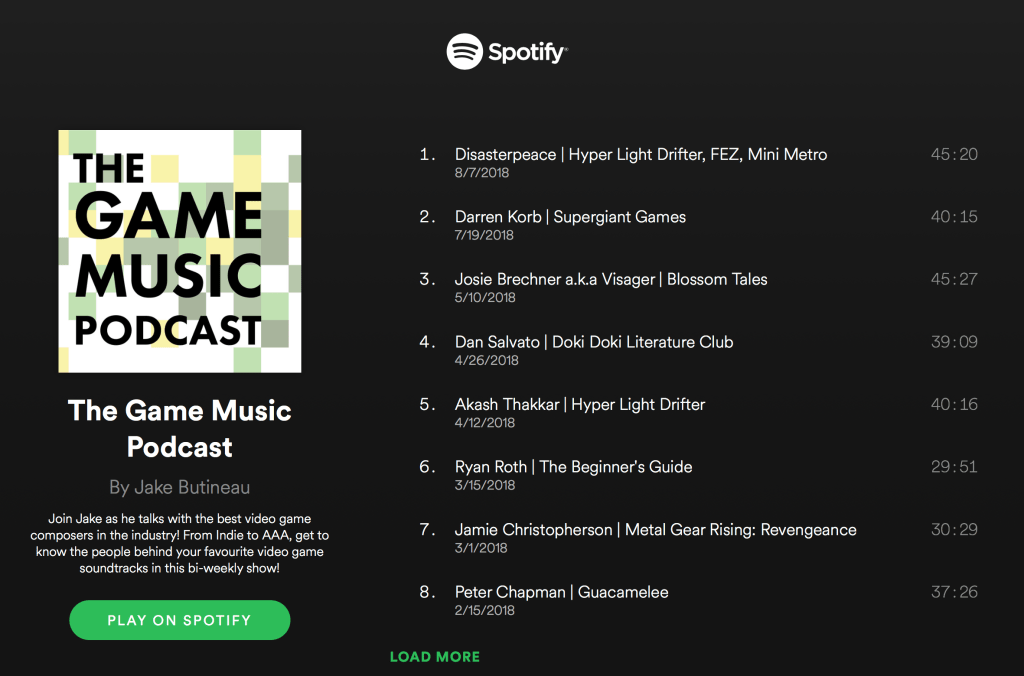
Today I was listening to ‘The Game Music’ Podcast, an American composer called ‘Disasterpeace’ (Richard Vreeland) discussed his music and how he entered into the gaming world. Disasterpeace started off by experimenting with different sounds and loops, and that got me thinking that the sound world is all about experimenting and discovering. For example, Disasterpeace looped pieces from popular songs and created something of his own. He also experimented with different Garage Band and Logic Pro loops and instruments by changing the pitch, tempo, timbre etc until he reached something new.
There are a lot of ways to manipulate sounds. Nowadays technology allows you to record a simple sound and turn it to something completely different. In one of my Postgraduate lecture’s, myself and my coursemates were shown a video where ‘Tasos Fratzolas’ (owner and CEO of ‘Soundsnap.com’) described how he needed a submarine sound and he created it by recording someone jump into a pool. They manipulated the sound by time-stretching and pitch shifting the original sound file and eventually it sounded like a submarine.
Below is a very interesting video to watch especially for people who don’t know anything about film or game audio because it shows what’s actually happening behind the making of sound effects.
The beautiful lies of sound design by Tasos Fratzolas (2016) accessed November 30th 2019
As strange as it seems, a sound designer’s job is to make the audience unaware of the sounds going on in the background and make the sounds as natural and realistic as possible, that’s how you know a sound designer has done their job well. Whilst it seems like an easy job, the amount of hard work and detail that goes into one specific sound can be so precise and this process is repeated over and over again.
The magic of making sound (2017) accessed via youtube
The video above is another great example of how sound is designed for films, it really is surprising what goes on behind closed doors.
In my next blog, I will talk about my own experiences with sound design and the Postgraduate assignments that have helped me understand what sound design really is.
TEDX TALKS (2016) The Beautiful Lies of Sound Design| Tasos Fratzolas | TEDxAthens {online video} accessible by https://www.youtube.com/watch?v=jDy5j0c6TrU (accessed on 30th November 2019)
‘In October 1958, Physicist William Higinbotham created what is thought to be the first video game.’ this game was called ‘Tennis for Two’. (APS NEWS 2008)
Since then video games have rapidly advanced and like films, games need music too.
Although ‘Tennis for Two’ had no sound, it wasn’t long before someone invented a game with sound. In 1972 the video game ‘Pong’ was created, and that was the first video game with sound but in today’s modern era we now have access to video games that are as good as films and with that comes the epic, orchestral score of a blockbuster film.
In Michael Sweet’s eBook Writing Interactive Music for Video Games, Sweet reinstates the fact that ‘Writing music for games relies on many techniques inherited from dramatic film scoring’ (Sweet, 2015, p.g. 38) this shows the connection between both Film and Game music and why it’s easy to be so passionate about both.
During my undergraduate degree at the University of Hertfordshire I had a lot of practice with scoring music for games. For example in my 3rd year at University, myself and my coursemates were given the task of composing a ‘Vertical Slice’, this was to teach us how to prepare tracks for a games company, ready for them to implement our music in their game. It was an advanced task that helped showcase our technical and creative game audio skills.
Screenshot from Vertical slice assignment
Below are the links to 2 of the tracks I composed for the Vertical Slice assignment:
I learnt many interesting skills and techniques whilst completing this assignment. My lecture at the time suggested using a software called ‘Elias’, ‘The Elias Studio is game composer’s tool for intuitively arranging adaptive music scores with unrivaled ease of use. You arrange your pre-recorded music files and decide how the music will transition in the game. With this tool, the composer can have complete control of the game soundtrack, and make everything ready for the game developer.’
Video from Elias (2019) accessed via Youtube
With tools available such as ‘Elias’, becoming a game composer is much more possible than it was years ago, especially since games are such a dominent feature in today’s society.
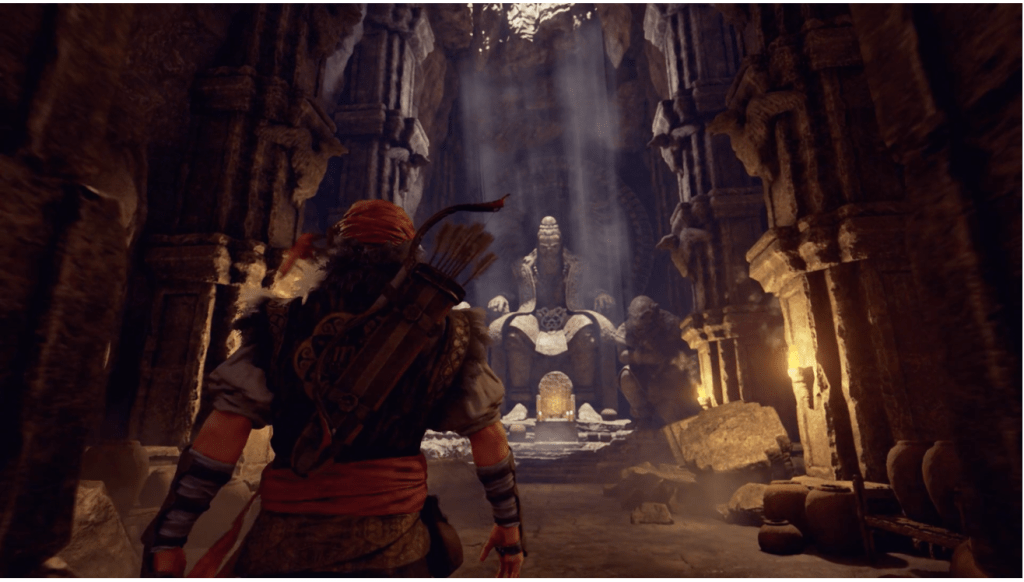
Another example of me scoring for a game was my Final Major Project in my 3rd year at University. I was hugely inspired by the game ‘Horizon Zero Dawn’ (2017) the music was such a massive part of this game, composer ‘Joris De Man’ was the genius behind the soundtrack, he managed to captivate the players by marrying his picture to the music. The use of a hybrid orchestra was used to reflect the machines patrolling on the natural environment in the game and this is something I reflected in my own compositions for my FMP.
Horizon Zero Dawn (2017) accessed from Guerilla Games
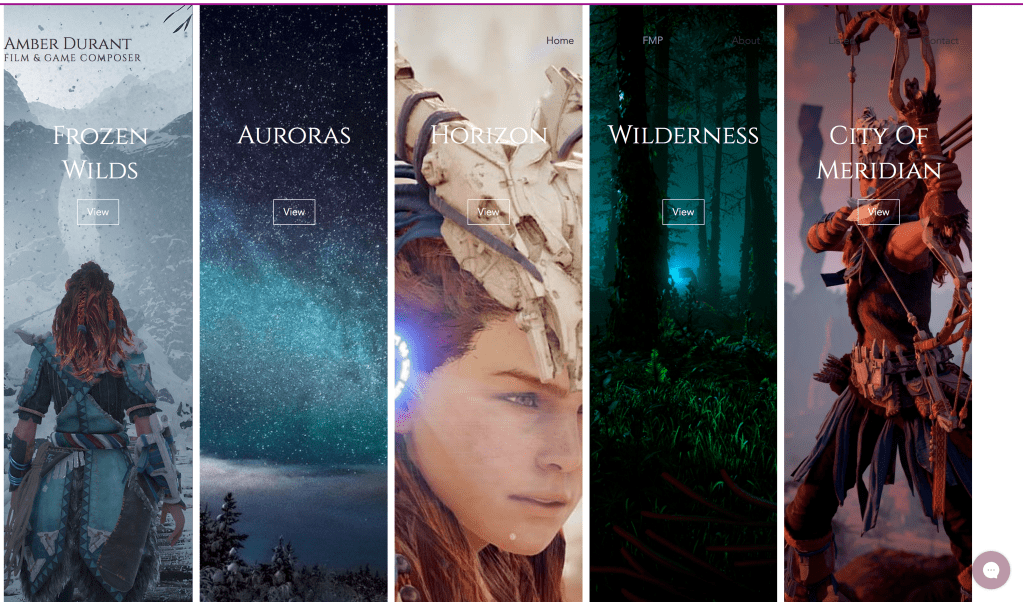
Screenshot of my own personal website dedicated to my FMP
For my FMP I had to create around 15 minutes worth of music, I decided to explore the different environments of the game, I screen recorded my PS4 gameplay sessions so I could compose new music on top of the footage, these 5 video clips were:
-A scene containing a wintery landscape that overlooks a volcano – FROZEN WILDS
– A scene thats contains combat and is set during the night time – AURORAS
-A scene based in the desert leading up to a royal city – CITY OF MERIDIAN
-Another night time based scene but a lot more ambient than the other night time scene. – WILDERNESS
-Finally I gathered lots of footage from the game and composed a new main theme to accompany the footage. -HORIZON
My FMP was a great way for me to showcase my skills, each video I created and composed the music to, required so many different techniques and it reflected how I could compose for different genres and environments.
My ‘Frozen Wilds’ track taught me how to compose to picture and how to convey emotion by injected music into the scene at the right time.
My ‘Auroras’ track taught me how to create tense music and it reflected what music would be like in a real game, for example when a character gets into combat with an enemy, the music adapts to fit the gameplay and thats exactly what I was trying to convey in my ‘Auroras’ track.
‘City of Meridian’ was a completely different musical experience for me, when composing the track I needed middle eastern sounding instruments, because I didn’t have access to those instruments, I overcame this hurdle by purchasing a Virtual Instrument called ‘Desert Winds’.
Desert Winds Virtual Instrument, created by Eduardo Tarilonte (2011) accessed from Best Service
Desert Winds allowed me to access an entire range of ethnic instruments, pads and drones. This along with the use of string instruments helped me create a very ethnic and regal sound to accompany the video. ‘City of Meridian’ taught me how to write music in an ethnical style.
‘Wilderness’ was a much more ‘laid back’ kind of composition, it was less about the music and more of the technical side to games. For example in the video attached below, just after 0:34 you will see how I dipped the music using automation when the main character ‘Aloy’ is focusing on a target this technique occurs throughout the video, it reflects what would occur in an actual game. The music in this video was composed to be ‘background’ music because the player needs to concentrate and not get either distracted or bored of the music.
My final and most challenging track was ‘Horizon’ this was a main theme that lasts approximately 3 minutes and 45 seconds, this was difficult to write for because a main theme needs to be consistent and it should establish a motif throughout. I tried to incorporate the style of Joris De Man’s main theme for ‘Horizon Zero Dawn‘ by using live vocals and a hybrid orchestra. I believe I achieved that goal of incorporating his style in my track and I am overall very proud of my FMP.
This blog post is going to be an exciting one because I can talk about one of my favourite areas of music and that music in film.
Why is film music such a passion of mine? Well, I spent my entire childhood going to the movies, watching DVD’s before bedtime, coming home from school and sticking the tele on to watch shows like Scooby-Doo. Like I mentioned in my first blog post, I grew up in the late 90’s/early 2000’s, the films that were being made were outstanding and so magical but without the music to go with those films and shows, I don’t think the magic would’ve existed.
How did film music even start? I wondered this and decided to conduct some research. I came across a thesis written for the degree of Doctor of Philosophy at the University of Sterling by Mark Brownrigg, titled “Film Music and Film Genre” (2003). Brownrigg talked about early use of music in film in the 1900’s and stated that “Music was used to ease the audience to the world of film, preparing them for what was to come” (Brownrigg, 2003, pg. 30) he then mentioned an example of how the film Mrs Miniver (1942) contains a ‘cue derived from the chimes of Big Ben’ that ‘underscores the heroine’s opening rush through London’ (Brownrigg, 2003, pg. 30). Here Brownrigg is discussing how music in film was first used to set the scene of a film, in later years to come, music in film was used a lot more imaginitively and took the film world to another level.
Brownrigg talks about how in the late 1900’s\early 2000’s, soundtracks would rely on melody and the music would evolve along with the narrative of the film. Brownrigg states that composers such as John Williams would use ‘quasi-symphonic techniques of variation, reorchestration and modulation, also displaying an intricate and impressive use of the leitmotif’. (Brownrigg, 2003, pg. 31) This took film music to the next level, instead of music just accompanying the film and setting an atmosphere, music became part of the structure to make a film so great. The use of leitmotif would act as a ‘musical “signature” to different characters, places, emotions and so on’ (Brownrigg, 2003, pg. 30). Star Wars (1977) is a great example of this, as soon as ‘The Imperial March’ is played we all know that a tall, scary guy in a shiny black suit with a breathing problem is going to appear on the screen.
Darth Vader (by unknown) source:google images (accessed 18th November 2019)
In more recent times, our screens have been blessed with great films, a few of my favourite have been, the How To Train Your Dragon (2010-2019) series, Avengers Endgame (2019) and Frozen 2 (2019). Yes I know there are all kids films and yes they all made me cry but i’m a film nerd, that means I get more emotionally attached to films than I should do and it doesn’t help that the music is so impactful. The video I inserted below is an interview with composer John Powell, the genius behind the soundtrack to How To Train Your Dragon (2010-2019).
Powell has his own Youtube page and in some of his videos he shows piano rolls of his tracks for ‘How To Train Your Dragon‘ (2010-2019). This helps me with my own compositional strategy as it allows me to see how to structure compositions and what instruments to use where and when.
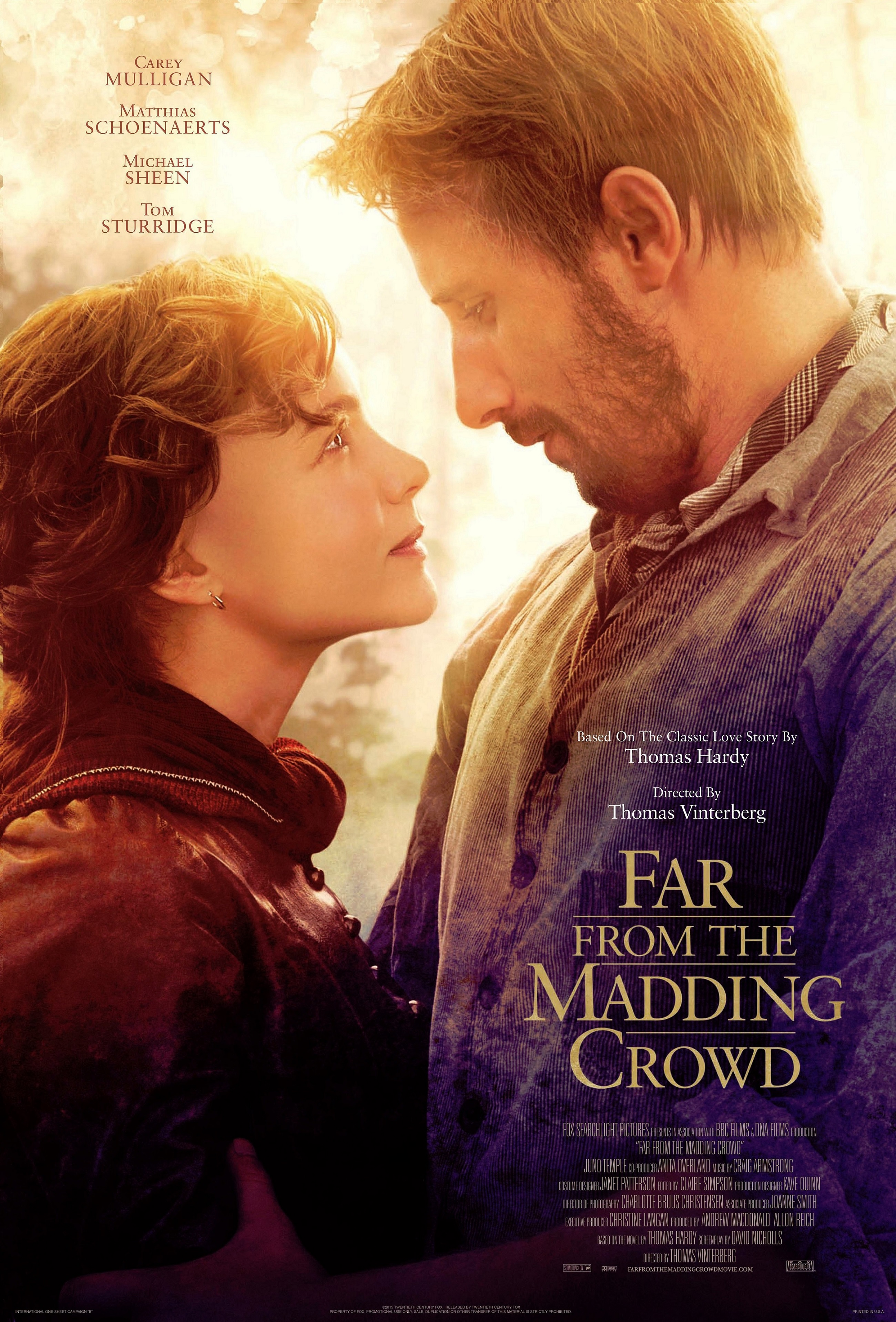
Another soundtrack that has become very helpful to me is ‘Opening’ a track from the film Far From The Madding Crowd (2015). The soundtrack in this film is completely orchestral and very minimal in terms of instrumentation, it shys away from the typical heavy orchestrated music heard in popular films, this could be due to the genre of the film, it’s a romantic film, therefore light instrumentation is recommended and the use of strings and piano is common. Brownrigg mentions in his thesis that ‘the prominent use of the instrumental combination of foregrounded solo piano and supportive strings’ are ‘very much a signature sound of the genre.’ (Brownrigg, 2003, pg. 156) he then continues to say that if tuba and drums were played during a romantic scene, it would not have the right effect on the atmopshere of the film.
Far From The Madding Crowd (2015) source: google images ( accessed 18th November 2019)
After reading Brownrigg’s thesis and listening to romantic orchestral music, I used the knowledge that I gained whilst studying this and incorporated it into my own music, I now feel confident that if asked to create a piece of music in the romantic style, I could deliver a composition quite suited to that genre.
In a bid to reflect the certain styles of music, I must have access to the right sounds and instrumentation. Unfortunately, I am a student so I can’t really afford to hire a full orchestra or professional solo players. So the way I get around this is Virtual Instruments, this allows me to compose musical scores on a low budget and still at a high enough standard for the industry. For example, I have recently purchased the ‘Joshua Bell Violin’ from Embertone, it sounds just like the violin used in Far From The Madding Crowd (2015). These technological tools help develop my skills at replicating real orchestral sounds which is a key skill to have when entering the music industry.
Sources:Variety (2014), Variety Artisans: Emotional Pleasures – The Music of ‘How To Train Your Dragon 2’,{online video}, 31 Oct 2014, accessible by: https://www.youtube.com/watch?v=5YkLOxMilnA, (video accessed on 18th November 2019)
MARK BROWNRIGG, Film Music and Film Genre, (2003), {acessed online}, University of Stirling, thesis, link to thesis can be found: https://core.ac.uk/download/pdf/40108516.pdf (thesis accessed on 18th November 2019)
JOHN POWELL (2019) How to Train Your Dragon: The Hidden World: 1m2a Busy Busy Berk, {online video} 22 Feb 2019, accessible by : https://www.youtube.com/watch?v=VeAxP5w2Vsc (video accessed 18th November)
Welcome back to my blog, this is my second blog post and looking at the title, you guessed it! It’s all about the ladies in this post. As I previously hinted about my struggles of being a woman in this industry, I want to talk about other female composers who have been on their own journey that’s inspired me to be resilient.
Like I mentioned in my first blog post, I have received much doubt about my passionate for music and my drive to pursue a career in the industry. I was supported a lot more as a child because I think most people thought music was just a hobby for me but I was instantly enchanted by the unbreakable spell that music cast on me and there was no way music was just going to be a hobby of mine.
Before my late teenage years, I would push my musical abilities to the limit, I’d perform classical piano pieces in school assemblies, churches, awards evenings and even weddings. I eventually started performing my own piano compositions and in 2016 I was presented with an award for my original composition. This gave me the confidence I needed to reassure myself that music was going to become my career.
However, during my late teens/early 20’s I started to see a different side of the music industry. When people discovered that I was actually pursuing a music career and I identified myself as a professional, I noticed that people weren’t taking me seriously and I experienced my first encounter with sexism.
I decided to enrol at the University of Hertfordshire due to the diversity and down to earth atmosphere that I experienced on the open day but before this I had to explore different options to extend my musical curriculum. On one occasion, I attended an open day of a musical facility and was welcomed with “oh you are here for the open day, you don’t look like a composer”. I was put off completely from the open day and decided against that music facility as an option of study. It wasn’t just that occasion where i’ve been treated differently but on numerous other occassions too where I really experienced the gender difference in the music industry.
Having witnessed the prejudice against the female gender only motivated me to push harder and thrive for a successful career in music.
Not only myself but other women have endured the same kind of prejudice in the music industry.
I came across an interesting book, Women & Music A History, that discusses many things especially how women who were born in the 20th century and studied at the Royal College of Music and even worked under the likes of Ralph Vaughan Williams and Gustav Holst still ‘struggled with their careers, not only because they were forward-looking composers but also because they were women.’ (Pendle,1991, pg.227) Pendle then goes on to say that although these women never felt discriminated against during their time at the RCM, when they were out of college and in a professional environment, they did struggle to ‘organize performances where their works could be heard’ (Pendle,1991, pg.227). This correlates with my own personal challenges that I faced and I mentioned it earlier in my blog that I too was faced with sexism when I entered a professional environment.
So how did these women manage to musically thrive in such a patriarchal society ? It seemed very difficult but certain women made sure that girls like myself could follow their musical ambitions. In 1911 the ‘Society of Women Musicians’ organisation was founded, to ‘deal with the problems of invisibility among women composers and performers’ .(Pendle,1991, pg.227). Also, in the early 1920’s ‘Anne Macnaghten in collaboration with conductuer Iris Lemare and composer Elisabeth Lutyens, established the recently disbanded Macnaghten-Lemare series as a platform for performances of modern British Music’ (Pendle,1991, pg.227). So even as early on as the start of the 20th century, women were standing up for their passion.
I feel that myself and Elisabeth Lutyens, one of the female composers I mentioned, are very similar. After reading through a passage in Women & Music A History, I couldn’t help but notice similarities in Lutyen’s life compared to mine, she was brought up in a none musical family and she ‘studied both piano and violin practicing many hours a day, and began to compose in secret’ (Pendle,1991, pg.228) she also developed an interest in Debussy too. Maybe I am ELisabeth Lutyens reincarnated…
Anyway, what i’m trying to say is that female composers in the 1900’s weren’t too different from female composers today, there is still a battle going on for women to be heard and accepted in this industry.
Speaking of women in the industry today, I was very pleased to see the BAFTA Cymru award-winning composer Alexandra Harwood invited to one of our lectures to give a talk on what its like to be a part of the music industry. She gave such a great talk that left me inspired. I noted down a few points she made during her lecture:
-Firstly, Harwood spoke about the late James Horner and how he said “In the film world you can’t revisit your own composition as it no longer belongs to you” (Harwood, quoting a comment from Horner)
-To use the ‘gentle art of manipulation’
-To be open minded and objective
-‘find a way to sound like you around the temp track you were sent’ but without sounding like the temp track too much or you’ll get sued
-Write in the style thats ‘in trend’ for example she spoke about Hildur Guðnadóttir and how her style of music is in trend right now and many film directors are looking for her type of sound and will hire composers if they can replicate her style
-Directors can be difficult, do what they ask but dont lose your sense of uniqueness.
After Harwood’s talk, I went home to reflect on the points she made. I thought about the style of music I compose in and if that would secure me a job or would I have to adapt my style to fit with the trend that’s occuring at the current time. Harwood’s talk was very reassuring and inspiring, to see a female composer score succesful films like ‘The Guernsey Literary and Potato Peel Society’ and working for companies such as ‘Disney’ and the ‘BBC’, I was left feeling very hopeful that I was on the write path in life.
ALEXANDRA HARWOOD, (2019), Breaking into the film composing business. {Lecture}, (MA), University of Hertfordshire, (lecture attended on the 14th November 2019)
Hello readers and welcome to my blog, let’s keep this short and sweet, I’m Amber, a composer currently studying the MSc (Hons) Music and Sound for Film and Games course at the University of Hertfordshire.
WARNING! If you don’t like Music, Films or Games then stop reading immediately, this blog is only for the passionate people that are dedicated to the world of music.
I hope you music fanatics enjoy my blog, let the fun begin…
So firstly, a little background information about myself, you may wonder why I’m such a geek when it comes to music, I’m a 90’s baby so I grew up on Disney, Harry Potter, Jurassic Park, Lord of the rings, Star Wars and more. Speaking of which, when Lord Of The Rings The Two Towers came out in the cinema, I went to go watch it with my mum, I was 4 years old, how I managed to sleep in my bed I will never know, those orcs were scary.
The music in the films I grew up with was magical, it married the sound with the picture and I was instantly mesmerised, name any Disney film and I guarantee I can sing the lyrics to the majority of the songs in the film. A few of the films I grew up on have one thing in common and that’s John Williams, whilst I was watching those films, Williams was secretly brainwashing me to follow the path of music, it wasn’t long before I was paying more attention to the music than what was occurring on screen, that’s when I knew music was going to be a huge part of my life.
To continue to my musical journey, I began piano lessons at the age of 7 advancing year after year, completing all my grades right the way through till Grade 8 and yes, I had to do my Grade 5 Theory, thank goodness that’s over and done with.
Learning the piano opened up my ears to the classical side of music and how most film music is based on classical scores. Have you heard of ‘Kings Row’ by Erich Wolfgang Korngold? It sounds very similar to a certain galactic space franchise theme tune *cough* ‘Star Wars’ *cough* I think Williams borrowed a few themes from the great classical composers knowing full well he could avoid a hefty lawsuit but who cares, he’s a living legend, we’ll let you off this time, John.
John Williams was inspired by other composers and he incorporated that inspiration into his compositions and I too do the same. After a few years of learning the piano, I became fascinated with different styles of music, especially the romantic and minimalistic styles of Claude Debussy and modern composer Ludovico Einaudi. Instead of sitting around learning other composer’s music on the piano, I started to wander off into my adventure and I began composing original piano pieces and that is what led me on the path that I am still on today.
When I first applied to study music at university, I had a lot of people questioning my choices, musicians don’t exactly have it easy, most of us are freelancing whilst working a part-time job on the side and as a woman, I knew my musical journey wasn’t going to be easy.
This leads to my next blog post that will talk about women in the music industry.
sources: EDWARD (2015) John Williams Borrowing from Other Composers, {Online Video}, 9 Jun 2015, accessible by: https://www.youtube.com/watch?v=JtRU8cMp0Nk (Video accessed on 20th October 2019)